“Does your school have a cemetery?”
That's a question from Dr. Josh Bonde, a citizen of the Temok Tribe of Western Shoshone and director of the Stewart Indian School Cultural Center and Museum, to his kids during a lesson about federal Indian Boarding Schools.
“And then you see the gears start turning, you know, they're like, 'No, like why would a school have a cemetery?'" he said. "Because kids didn't get to go home. You know, some kids never went home, never got that opportunity to see their families again.”
That includes students like Della Tuscarora Atkins, a 17-year-old Shoshone girl. She died 126 years ago, on December 25, at the Carlisle Indian Industrial Boarding School in Pennsylvania, some 2000 miles away from home.
Her grave was one of 190 discovered near the school by the Office of Army Cemeteries, in an ongoing effort to repatriate students. The Shoshone-Paiute Tribes of the Duck Valley Reservation have spent two years on the process.
The tribe's Public Affairs Officer, Marco Ovando, worked on Della’s repatriation. When she was enrolled in the school, they misspelled her last name.
“We got to work and looking at the enrollment records, historical records, family, oral history, a huge task was undertaken to figure out that the individual that we were looking for was my great-great aunt, Della Atkins," he said.

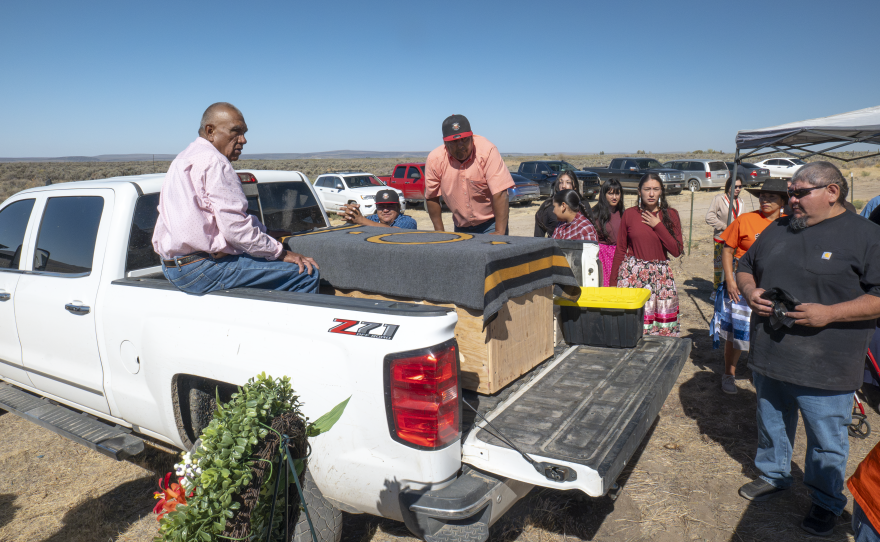


Three of his matriarchal elders determined that Della had moved from Duck Valley to Carlin, Nevada, which is where other relatives lived at the time.
“Because Duck Valley is so isolated geographically, we kind of were in our own little bubble away from the traumatic epicenters of what the boarding school era was,” Ovando said.
No Native American family in Nevada is unaffected by the boarding schools, according to Bonde.
Learning Della’s past has been a very impactful discovery for the Atkins family.
“It really shook our world up to where we thought we were avoiding it... to now we're being entangled into this larger web and [it] made us realize that the boarding school era has far more reach than anyone anticipated,” Ovando said.
It was Della’s seventh generation -- seven being a sacred number to many tribes -- that returned her from Pennsylvania to the Duck Valley reservation.
“Once we realized that there was an individual from Carlisle boarding school coming home, we were all hands on deck to ensure that she had the best welcome home anyone expected,” he said.
Tribal members waited for Della at the reservation's northern entrance. As they brought her through, songs, prayer, and the warmth of the Sho-Pai tribal community welcomed her.
They then transported her to Owyhee, Nevada. She was reburied the next day in the family plot at the cemetery, surrounded by family and community members looking to begin the healing from generational trauma. Bonde has seen what that trauma has done to Indigenous families across the nation and in Nevada.
“So that significant disruption of the family unit for multiple generations has created this socioeconomic cycle of poverty," Bonde said. "You have abuse, you have substance abuse, you have physical abuse, and all of these situations lead to, you know, fall within that whole cycle of poverty. And so poverty in Indian countries is prevalent and can be almost directly tied back to traumas associated with the Indian boarding school era.”
Origin stories and traditional practices have been lost along the way.
“My parents' generation and maybe a little bit the generation before them, they didn't want us speaking our language because of the bigotry they faced,” he said.
The U.S. government ended Indian Boarding schools after President Jimmy Carter changed federal policy in the late 1970s. In 1980, Nevada's Stewart Indian Boarding School in Carson City ceased operations.
Bonde thanks those in the community with the foresight to preserve their native languages, which are now being taught to kids on Native reservations.
“I don't speak Shoshone. My mom speaks a little bit of Shoshone, but maybe my kids have the opportunity to become fluent. And I think that's fantastic because I think language is the first layer of culture,” Bonde said.